Highlights from the Smart Mobility & Green Cities discussions in Rome. The conversations brought together perspectives from public institutions, industry and sustainability leaders on the future of urban transition.
📍 Rome, Italy | January 2026
🌱 Key Takeaway
The transition is no longer primarily a technology challenge.
It is increasingly a systems challenge involving infrastructure, energy, data, finance, governance and human behaviour.
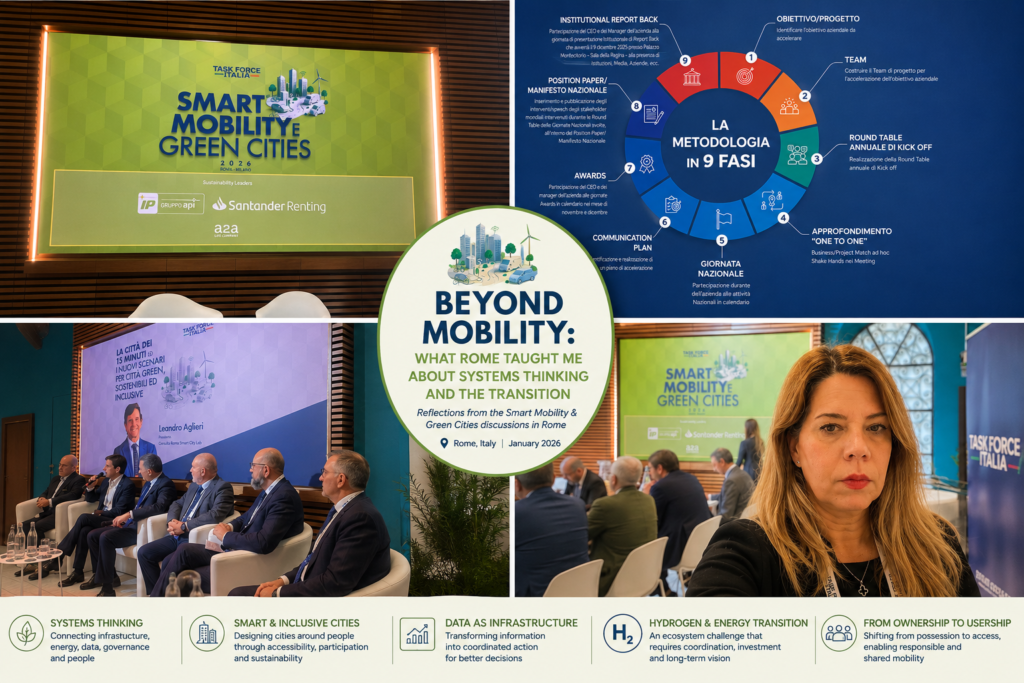
Smart Mobility & Green Cities Task Force, Rome, January 2026
Introduction
Earlier this year, I had the opportunity to participate in discussions in Rome as part of the Smart Mobility & Green Cities initiative.
Before attending, I expected conversations about transportation technologies, electric vehicles, charging infrastructure and future mobility solutions.
Those topics were certainly present.
However, what surprised me most was that the discussions repeatedly moved beyond transportation itself.
Instead, they focused on something much broader: how cities, energy systems, infrastructure, data, finance and human behaviour must evolve together to support the transition ahead.
The more I listened, the more I realized that mobility was not really the topic.
Mobility was simply the lens through which a much larger transformation could be observed.
🚗 The Vehicle Is No Longer the Story
For decades, mobility discussions largely focused on vehicles.
How do we make cars faster, safer, cleaner or more efficient?
Today, the conversation appears to be changing.
Throughout the discussions in Rome, mobility was increasingly presented as an ecosystem rather than a transportation sector.
The focus extended well beyond vehicles to include:
- urban planning
- energy systems
- digital infrastructure
- public transportation
- logistics
- governance
- financing mechanisms
- citizen engagement
One idea repeatedly emerged:
The vehicle is no longer the story.
The network is.
Success increasingly depends not on individual technologies, but on how effectively different systems can work together.
🏙️ Cities Are Becoming Living Systems
One of the recurring themes throughout the seminar was the concept of the 15-minute city.
Originally developed by Carlos Moreno, the concept is built around four principles:
- proximity
- ecology
- participation
- solidarity
The objective is simple: essential services such as work, education, healthcare and daily needs should be accessible within a short distance from where people live.
Yet the broader significance goes far beyond reducing travel times.
The concept reflects a different way of thinking about cities.
Rather than designing cities around traffic flows, it encourages us to design them around people.
This perspective closely aligns with the principles of Sustainable Urban Mobility Planning (SUMP), which shifts the focus from managing traffic to improving accessibility, quality of life and citizen participation.
One phrase from my studies came back to mind while listening to these discussions:
Planning for people, not traffic.
Related initiatives such as Rome Solar City and discussions around behavioural monitoring through tools like the Green Box reflected a similar philosophy.
Rome Solar City was presented as a broader vision for integrating renewable energy, urban planning and citizen participation into the future development of the city.
The objective was not only to improve environmental performance, but also to rethink how cities can become more resilient, liveable and energy-aware.
Similarly, the Green Box initiative highlighted the growing importance of understanding real mobility behaviours.
Rather than relying solely on assumptions, the concept focuses on collecting data related to traffic patterns, pollution, noise and mobility choices to support more evidence-based urban planning and policy decisions.
What interested me most was not the technology itself, but the underlying shift in thinking.
Cities are increasingly being approached as living systems.
📊 Data Is Becoming Infrastructure
Another theme that appeared repeatedly throughout the discussions was the growing role of data.
Artificial intelligence, digital platforms, connectivity and mobility services were discussed extensively.
Yet the conversation was rarely about technology for its own sake.
Instead, it focused on decision-making.
One observation remained with me:
We have data to know what to do and where to do it.
The challenge is no longer collecting information.
The challenge is transforming information into coordinated action.
As cities become more connected, data itself is beginning to function as a form of infrastructure.
Just as roads, railways and energy networks support physical movement, data increasingly supports coordination, planning and system optimisation.
Collecting data is relatively easy.
Using it effectively may be the more difficult task.
🔄 From Ownership to Usership
One of the strongest connections I noticed between the Rome discussions and my academic studies was the changing relationship between people and mobility.
Traditionally, mobility has been associated with ownership.
Owning a vehicle represented convenience, independence and status.
Today, concepts such as Mobility as a Service (MaaS), car-sharing and integrated transport platforms suggest a different direction.
The emphasis is gradually shifting from ownership to usership.
From property to responsibility.
Mobility becomes a service rather than an asset.
The objective becomes access rather than possession.
This may appear to be a technological change, but it is fundamentally a behavioural one.
And many sustainability transitions ultimately depend on behavioural change.
Technology can support transformation.
Infrastructure can enable transformation.
But people remain central to transformation.
⚡ Hydrogen Is Not a Technology Story
Hydrogen was one of the most visible topics throughout the seminar.
Hydrogen Valleys, green hydrogen projects, industrial applications and transport solutions featured prominently in many discussions.
Yet what stood out was that the conversation rarely focused on hydrogen itself.
Instead, it focused on implementation.
- How do we create demand?
- How do we develop infrastructure?
- How do we attract investment?
- How do we scale?
From a technical perspective, hydrogen is often described as an energy carrier rather than an energy source.
But from a transition perspective, hydrogen may be better understood as an ecosystem challenge.
Production, storage, transportation, regulation, financing and market demand must all evolve simultaneously.
The limiting factor is often not innovation.
It is coordination.
🏗️ Technology Is Not the Bottleneck
Perhaps the most important lesson I took away from Rome was that technology is no longer the primary constraint.
Electric mobility exists.
Hydrogen technologies exist.
Artificial intelligence exists.
Renewable energy technologies continue to mature rapidly.
The more difficult questions relate to implementation.
- How do we align stakeholders?
- How do we create enabling policies?
- How do we reduce investment risks?
- How do we encourage behavioural change?
- How do we scale solutions beyond pilot projects?
These questions appeared repeatedly regardless of the topic being discussed.
And they all point toward the same conclusion.
The transition is not only a technological challenge.
It is also an institutional, financial and societal challenge.
🌐 The Transition Is Ultimately a Systems Challenge
Looking back, the strongest message from Rome was not about mobility, hydrogen or smart cities.
It was about systems.
Mobility cannot be separated from energy.
Energy cannot be separated from infrastructure.
Infrastructure cannot be separated from finance.
Finance cannot be separated from policy.
Policy cannot be separated from people.
And none of these can be addressed effectively in isolation.
Perhaps that is why so many discussions returned to concepts such as collaboration, interoperability, integration and governance.
The future will not be shaped by individual technologies alone.
It will be shaped by our ability to connect systems that have traditionally been managed separately.
In that sense, mobility may simply be one of the most visible examples of a broader transition already underway.
A transition that requires not only innovation, but also coordination.
Not only technology, but also participation.
Not only ambition, but also implementation.
Ultimately, the question is no longer whether change is coming.
The question is whether we can build the ecosystems needed to make that change scale.
🇹🇷 What Could This Mean for Türkiye?
While many of the discussions focused on European cities and infrastructure ecosystems, they also prompted broader reflections on what similar transition pathways could mean for Türkiye.
In many ways, Türkiye is already engaging with several dimensions of this transformation.
Renewable energy capacity continues to grow, electric mobility adoption is accelerating, and interest in hydrogen is gradually increasing.
At the same time, European decarbonisation policies are creating new expectations across industrial value chains.
What struck me most, however, is that the key challenge may not be technological readiness alone.
Many of the questions discussed in Rome are equally relevant for Türkiye:
- How do projects become bankable?
- How do we create long-term investment visibility?
- How do we align public policy, infrastructure development and private sector investment?
- How do we move from pilot projects to scalable solutions?
From a sustainable finance perspective, these questions are becoming increasingly important as transition pathways require not only technology and infrastructure, but also long-term investment confidence, risk-sharing mechanisms and scalable financing solutions.
Perhaps the most valuable lesson from Rome is that successful transitions are rarely driven by technology alone.
They depend on the ability to connect institutions, infrastructure, finance and people around a common direction of travel.
And ultimately, that may be one of the most important challenges and opportunities ahead.
Because the success of the transition may depend less on individual technologies and more on our collective ability to connect systems, institutions and people around a shared vision for the future.
The ideas shared in this article are personal reflections inspired by the Smart Mobility & Green Cities discussions in Rome, complemented by insights from my academic studies and additional research
Yeşim Sarısu
Sustainable Finance & ESG Professional